I started building new beds in the last couple weeks. It will probably take me until next spring, if not the following spring before I finish them. I will probably wait for next fall before anything is planted in them. I am in no hurry. My plan is to build one or two of these each year, so there are beds always “under construction.”
My garden is in an area where some 150 years ago folks discovered gold. That set off an incredible land rush. ‘Forty-niners’ came looking for gold and destroyed much of the landscape in the process. When the gold ran out the settlers turned to logging; cutting the trees for timber and damning up the creeks for power for their sawmills. Next came the cattle. With so much land where the trees were, they ran cattle for decades. Then the land gave out, being poorly managed for over a century. The cattlemen became land developers. The old gold tailings were bulldozed and mixed in with the depleted soils and sold as “ranchettes.” That’s where we came in. My wife and I bought a home on a 3-acre ranchette. We had dreams of a self-sustaining small homestead. Those were great dreams but, alas, we didn’t know what we were doing and picked a poor spot.
The land is depleted land; our homestead is three acres of solid clay mixed with mine tailings. If you try to work the soil in the winter you find yourself knee deep in muck. If you try to work it in the summer it is like trying to dig in concrete. Neither approach results in a decent garden, let alone a homestead. We had to find a different approach. We found one. We built raised beds on top of the “soil.” No double digging like I learned reading Jon Jeavons book years ago. That just isn’t possible here.
I start building a bed by laying some old, punky wood on the ground. Sometimes it is old firewood that I ran through a compost pile or two. Sometimes it is burned wood, salvaged from nearby wildfires, sometimes it is scrap 2×4’s from various projects. And sometimes it is wood that floated down the creek from parts unknown. I am not talking about a full-on Hugelkultur. We learned from experience that in this area those quickly become dorms for a variety of ground-dwelling rodents! I don’t want a lot of wood, just a single layer of various sizes, shapes, and types.
There is no digging or measuring, That’s not how I roll. I just lay the wood out in approximately the place I want the bed. Then I start piling on dirt. Not all at once, I don’t want to work that hard! Just a little at a time. I will wander around the property looking for gopher, mole, vole, or ground squirrel holes and scoop up the dirt around the hole. (I am sure to thank the ground-dwelling rodents for their work as I scoop up the dirt!) I use dirt from cleaning out the culvert under the driveway. I will use dirt that has eroded from higher ground. I use any dirt I find. That is partly why it takes so long to build a bed. The bed is mostly made of scrounged stuff. I will add buckets full of flotsam gathered from the high watermark of trees in and around the creek to add organic matter. As the year progresses I will add small clippings from the willow trees that are so abundant around here. Anything I can that adds organic matter goes into the bed. Once it is finally near the size I want it to be (in a year or two) I will start dumping compost on top. I use both store-bought and home-made. (I can’t make near enough compost at home. Yet.)
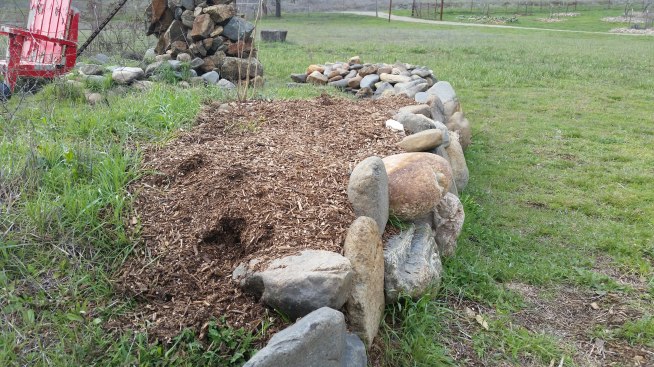
A raised bed under construction. The rock edge will be completed all around the bed, then thyme and snow in summer will be planted between the rocks.
Once the bed is the right size, I begin bringing in rocks to form the sides of the bed. The rocks define the bed and serve to help warm it up in the springtime. I plant low growing ground cover perennials among the rocks. Strawberries, thyme, snow-in-summer and the like. These plants help hold the rocks in place, and serve to shade the rocks in the summer, so the bed does not get too hot.
Once the bed is in place I will plant a fruit tree or two, and several perennial edibles. Asparagus, rhubarb, and horseradish are among the favorite choices. I will then fill in the remaining space with annuals for a couple years. When the perennials are established and the soil is a fungal dominate one the annuals will no longer do well. I will fill in the spaces with other perennial plants and move the annuals into the other new beds, starting the whole process again.
That’s the process, now I have some dirt to go gather.
 Our Mountain Ranch Gardens
Well, at least you have good granite stone. All I had to work with was sandstone that deteriorates after a while.
LikeLike