Well, it is a new year, I have a new haircut, and it’s time to talk about what is going to be new in the garden this year. I try every year to have lots of new things mixed in with the old stalwarts, But today I have 5 new plants that I am really excited about adding to the gardens.
This first plant-Hypericum perforatum or Saint John’s Wort- “Topas”, is a plant we picked up at the Occidental Arts and Ecology Center nursery the last time we were over in that area. This nursery is awesome. It is small, well, ok, it is tiny, but they have things you will not find anywhere else, and it is all grown organically and regeneratively to boot! The next time you are up in the Napa/Sonoma wine region this nursery is worth the time. And leave some time for some good Italian food in the town of Occidental CA.

Image CC BY-SA 3.0 by H. Zell
We grow a number of different herb plants here in our gardens. While we have not grown this plant here, a neighbor has a big patch of it. They seem to be very deer resistant and frost hardy-two prime consideration here- and they are great for pollinators. This plant has yellow flowers that are really loved by the pollinators I am looking forward to the blooms. It will definitely be a plant I harvest for teas. Tea made from this plant has been found to be helpful for fighting depression. (Ng)
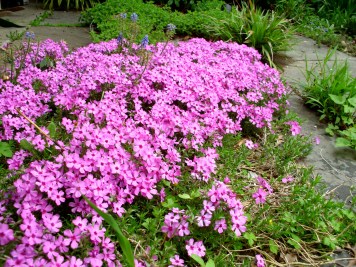
Another plant we picked up is this Phlox Subulata or moss phlox. This is a low growing creeping ground cover. We need lots of ground cover plants here to help keep the soil cool and supportive of the little things that dwell in the soil. It flowers in the blue-red spectrum, providing the pollinators with the pollen and nectar they need. I know exactly where I want to put it outside one of the gardens. If it does well, then you know we will be propagating and buying more!
These ground covers play a number of roles in our gardens. Keeping the ground covered, whether by plants or by mulch, is vital for the soil food web. The cover keeps the soil temperature down, and it slows the evaporation of water from the soil. Soil that is both moist and cool is more beneficial to the many organisms that live in the soil. These organisms then produce humus, which is sequestered carbon. The carbon, in turn, allows the soil to hold more moisture. (Ingham) The moisture in the soil, in turn, allows the plants to be more fire resistant, which is one of my primary goals for the land!
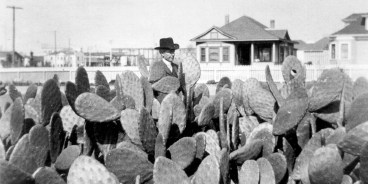
Photo from Luther Burbank.org
This next plant I ordered last spring after visiting the Luther Burbank Garden in Santa Rosa. Ca. If you haven’t been there, you need to go. Luther Burbank was an incredible plant breeder, if not a bit of a charlatan, being responsible for many of the plants we all enjoy today. This particular plant is the Luther Burbank Thornless Prickly Pear. I ordered this from Territorial Seed Company up in Springfield, Oregon. The legend has it that Luther Burbank was on a train ride through the desert in the eastern part of California and noticed all the cactus with their big thorns, and thought if he could breed out the thorns and ranchers could use the thornless cactus for cattle feed. Well, that didn’t work out, as the plant wasn’t all that he claimed it would be. It turns out the plant may not have been developed by Burbank after all. Rather, it may simply be a selection of one of the many thornless prickly pears grown by Native Americans in the South West. (Dreyer) But I do love the fruits, and many folks love eating the fronds. That is something I will need to learn about when this plant gets to harvest size.
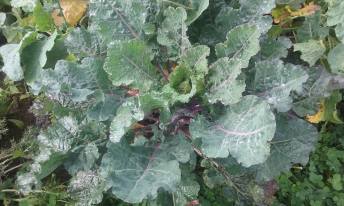
Image from ExperimentalFarmNetwork.org
Next up is this packet of seeds from the Experimental Farm Network. Check this out: Homesteader’s Kaleidoscopic Perennial Kale Grex. They had me at kale, but perennial? What the what? Put those two together and I just have to have it. We will see how it goes.
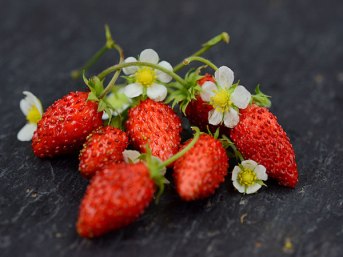
Image from Rareseeds.com
And lastly, but for sure not the least, is this packet of seeds from Baker Creek Seed Company, one of my favorite seed companies. I have gotten so many seeds from these folks. It is like I just have to give them my money. Really. These seeds are of Golden Berry Red Wonder Wild Strawberries or Fragaria vesca. Someone might say “but Mark, you already have so many strawberries. Why do you need more.” To that, I would answer with a pained look, and say “they are strawberries. You can never, ever have too many strawberries. If you can’t see that, you can’t be my friend!” Not really, you can still be my friend.
Now I am off to plant these seeds. I will see you next time I am looking at you. Until then, take care of yourself, take care of each other, and take care of the planet.
*This post was updated to include a higher quality video.
Works Cited
“CALIFORNIA CHAPARRAL INSTITUTE.” Top Chaparral Critters, http://www.californiachaparral.com/bprotectingyourhome.html.
Dreyer, P. THE PRICKLY LUTHER BURBANK “I See by the Papers…” comstockhousehistory.blogspot.com/2011/06/prickly-luther-burbank.html.
Ingham, E. R. “Natural Resources Conservation Service.” What Is Soil Conservation? | NRCS, http://www.nrcs.usda.gov/wps/portal/nrcs/detailfull/soils/health/biology/?cid=nrcs142p2_053868.
Ng, Q X, et al. “Clinical Use of Hypericum Perforatum (St John’s Wort) in Depression: A Meta-Analysis.” Current Neurology and Neuroscience Reports., U.S. National Library of Medicine, 1 Mar. 2017, www.ncbi.nlm.nih.gov/pubmed/28064110.
Plants Profile for Ledum Groenlandicum (Bog Labrador Tea), plants.usda.gov/java/charProfile?symbol=PHSU3.

 Our Mountain Ranch Gardens