Fall Chores

Fall, with it’s cooler days, means it is time to clean up the garden and prepare it for winter. I grew a little patch of corn, pumpkins, and beans. You know The Three Sisters. I had never made a serious attempt at this before, but it worked out fine. With the crop in and the remaining plant matter frost killed, it was time to cut everything back and plant the winter cover crop. But not in that order.

I am using a technique called ‘throw sow’ I first learned about throw sow when I read the book One Straw Revolution. In the book, Masanobu Fukuoka described how he would harvest the crop of the prior season, and then cast handfuls of seed around the plot, and then chop down the crop residuals to cover and mulch the seeds. Because I am not as young and spry as I once was, casting seeds about seems much more fun than stooping over to plant each individual seed the traditional way!

It has been found that there is a tremendous benefit to planting multiple species of plants in a single plot. Since my primary purpose for the bed this winter is to be a cover crop, increasing the nutrient and carbon content of the soil, I mixed some rye, hairy vetch, and clover seeds and soaked them in water overnight. The pre-soaking of seeds has been found to soften the outer shell of the seed, allowing for faster germination, among other things. The following day I drained the seeds and threw handfuls of seed around the plot that still had the dried corn stalks standing and frozen pumpkin plants covering the ground. I then proceeded to chop and drop the remaining plant material. The chopped plant material now serves as a mulch, covering the seeds and soil allowing the soil food web do its thing.

That is it. The bed is now planted and is on its way to spring!

Screen Shot 2018-12-31 at 9.13.12 PM

What about the deer?

We typically have two kinds of gardens in our neighborhood; fenced and unfenced. Our unfenced gardens have things like lavender, sage, rosemary, and other plants that deer typically do not like. Everything else goes behind a fence. All of the annuals and vegetables go behind a fence, lest the deer eat them all. When I say all, I mean the real all. The deer ate everything!

I have tried a number of times to try to grow annuals outside of the deer fence. At first, I just planted things like I always did- make a raised bed and plant. As soon as anything green appeared, it just as suddenly disappeared. I read about Sepp Holzer‘s throw sow method of growing and Masanobu Fukuoka’s techniques tried them. I thought maybe I just needed a diversity of crops planted very closely. I mixed together a variety of seeds and soil and cast them on the ground. Things soon sprouted, and just like previous attempts, they disappeared.

I knew it possible to grow in this area without fences because Matt Powers was doing it in a very similar area to the south of us. I had seen it work. I just had to figure it out.

This spring I had a bunch of seeds that had been lying around that I knew I would not ever get to plant in our fenced vegetable garden. There was just not enough room, and there was never going to be enough room. What the heck I thought, Why not give it a try. I mixed a bunch of seeds together- corn, amaranth, squash, radishes and anything else that was lying around. I soaked them overnight, mixed in some compost, and spread it willy-nilly in an area I had cleared. With our huge bird and squirrel populating I thought I needed to cover the seeds more, but I didn’t have any more compost. I grabbed some trimmers and went and trimmed a bunch of plants to use as mulch.

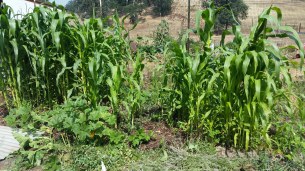
Garden picture

This patch of annual vegetables is on the outside of the deer fence. As seedlings, they were protected only with a thin mulch layer trimmed from deer resistant shrubs.

I week or so later I could see the little plants under the mulch! They hadn’t been eaten! They kept getting bigger and bigger, and the deer were pretty much ignoring them! It was the mulch that mattered. In one section I had used artemisia trimmings. Deer never touch that plant. I also had a section covered with trimmings from heavenly bamboo, and in the middle section, I used oregano trimmings. Three plants that I knew deer don’t touch. When looking at it now I can see that the deer did, in fact, browse down the middle oregano section. But the other two sections are doing very nicely indeed. Better even than the plants I started indoors and transplanted after danger of frost.  The only question will be if the plants mature before the killing frost comes. In the best case, I have a whole new huge growing area.  In the worst case, I will have a lot of biomass and a bunch of green pumpkins to put into a curry. Either way, I will call it a win.

Working on the soil

When we purchased this land over thirty years ago we bought three acres of yellow starthistle (yst).  The only places not covered with it was the house, the pump house, and the paved portions of the driveway. The yst was five and six feet tall in places, and super thick. This was the result of over 100 years of abuse of the land. First, it was the gold mining. Our land is in the Mother Lode region of the Sierra Foothills in California. The gold rush that began in 1849 happened right here. A gold-bearing creek borders one side of our land. That creek was heavily dredged and the leftover rock was just dumped on the land. There were also a number of hard rock mines in the area and the tailings had to go somewhere, so it went right here, on the land. Next came the loggers, and then came the overgrazing cattle. Finally came the developers, who bulldozed everything to try and make it all look good, with building sites and paved roads. That is a lot of abuse, and it isn’t going to heal overnight.

We tried a number of strategies to deal with the yst. We disked it all under. It looked good for a few months, but come spring the yst came back. We tried mowing it, but that just made shorter yellow starthistle. We tried digging it out. But digging anything out of heavy clay soil with very little organic matter in the summer is much easier said than done. We tried Roundup. I know. It was a terrible idea, and it didn’t work either. We couldn’t afford to buy that much Roundup, and it didn’t work all that well anyway. Our neighbors released some special wasps that lay their eggs in the flower, preventing the plant from going to seed. That put a dent in the problem. But it was a very small dent. Not enough to really make a difference.

We heard about a program being run by the Bureau of Land Management (BLM) that sounded promising.  If your land had dense enough yst, and your land was close to BLM land, they would provide a special spray that only attacks yst. They would give it to you for free. We called them, and someone from the County Agriculture office came out. Sure enough, we had dense enough yst and we are close enough to BLM land to qualify. At the appropriate time, the man came back with the chemical. About a half of a pint worth for our three acres. It was potent stuff.

I hated the idea of spraying, but we were really desperate. Fortunately, the spray worked.  Not 100%, but enough that I was able to go around the property and dig out the few plants that I found each spring. I have been doing that for about ten years now, and the difference is remarkable.

But removing the yellow starthistle doesn’t mean we have healthy soil. The soil is really good in our gardens, but everywhere else it is still heavy clay with very little organic matter.  So this winter I have been bringing in pickup truck loads of wood chips. I have probably brought in 15 truckloads in the last few months. I have been spreading it under our fruit trees, just beyond the drip line. I can already see a big difference in the soil under the first trees to get the chips. The soil has gone from red clay to black humus. It was just that easy.

But I have been thinking that bringing in wood chips is not really a sustainable approach. It is hard work, and while I can do it now, will I still be able to, say, twenty years from now? Thirty years from now? At some point, it will be just too hard. Also, while I have plenty of available wood chips now, if just a handful of neighbors decide this is a good thing, these chips will be very difficult to come by. And I really do not think I can grow enough trees to chip up to cover the land. That idea seems silly to me- grow trees just to chip them up.
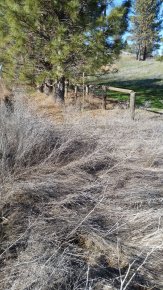
yellow star thistle and pine trees

The yellow starthistle is not growing under the pine trees.

Today while I was moving chips around I happened to glance over to my neighbor’s property. Several years ago the previous owner had planted several pine trees along our fence line. At the time I was upset because his trees were throwing shade on my tomatoes. Now the trees provide pine needle mulch for some blueberries.  Today I noticed that under those same trees is the only place on his property that is not covered with yellow starthistle! It is remarkable. There is no work being done in that area to combat the weeds, but the only thing on the ground is pine needles! It occurred to me that I do not have to worry about spreading wood chips forever. I just need to do it long enough to heal the soil, and then the land will take care of itself.