When we purchased this land over thirty years ago we bought three acres of yellow starthistle (yst). The only places not covered with it was the house, the pump house, and the paved portions of the driveway. The yst was five and six feet tall in places, and super thick. This was the result of over 100 years of abuse of the land. First, it was the gold mining. Our land is in the Mother Lode region of the Sierra Foothills in California. The gold rush that began in 1849 happened right here. A gold-bearing creek borders one side of our land. That creek was heavily dredged and the leftover rock was just dumped on the land. There were also a number of hard rock mines in the area and the tailings had to go somewhere, so it went right here, on the land. Next came the loggers, and then came the overgrazing cattle. Finally came the developers, who bulldozed everything to try and make it all look good, with building sites and paved roads. That is a lot of abuse, and it isn’t going to heal overnight.
We tried a number of strategies to deal with the yst. We disked it all under. It looked good for a few months, but come spring the yst came back. We tried mowing it, but that just made shorter yellow starthistle. We tried digging it out. But digging anything out of heavy clay soil with very little organic matter in the summer is much easier said than done. We tried Roundup. I know. It was a terrible idea, and it didn’t work either. We couldn’t afford to buy that much Roundup, and it didn’t work all that well anyway. Our neighbors released some special wasps that lay their eggs in the flower, preventing the plant from going to seed. That put a dent in the problem. But it was a very small dent. Not enough to really make a difference.
We heard about a program being run by the Bureau of Land Management (BLM) that sounded promising. If your land had dense enough yst, and your land was close to BLM land, they would provide a special spray that only attacks yst. They would give it to you for free. We called them, and someone from the County Agriculture office came out. Sure enough, we had dense enough yst and we are close enough to BLM land to qualify. At the appropriate time, the man came back with the chemical. About a half of a pint worth for our three acres. It was potent stuff.
I hated the idea of spraying, but we were really desperate. Fortunately, the spray worked. Not 100%, but enough that I was able to go around the property and dig out the few plants that I found each spring. I have been doing that for about ten years now, and the difference is remarkable.
But removing the yellow starthistle doesn’t mean we have healthy soil. The soil is really good in our gardens, but everywhere else it is still heavy clay with very little organic matter. So this winter I have been bringing in pickup truck loads of wood chips. I have probably brought in 15 truckloads in the last few months. I have been spreading it under our fruit trees, just beyond the drip line. I can already see a big difference in the soil under the first trees to get the chips. The soil has gone from red clay to black humus. It was just that easy.
But I have been thinking that bringing in wood chips is not really a sustainable approach. It is hard work, and while I can do it now, will I still be able to, say, twenty years from now? Thirty years from now? At some point, it will be just too hard. Also, while I have plenty of available wood chips now, if just a handful of neighbors decide this is a good thing, these chips will be very difficult to come by. And I really do not think I can grow enough trees to chip up to cover the land. That idea seems silly to me- grow trees just to chip them up.
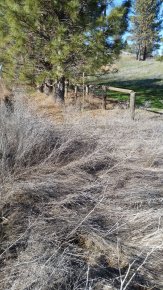
The yellow starthistle is not growing under the pine trees.
Today while I was moving chips around I happened to glance over to my neighbor’s property. Several years ago the previous owner had planted several pine trees along our fence line. At the time I was upset because his trees were throwing shade on my tomatoes. Now the trees provide pine needle mulch for some blueberries. Today I noticed that under those same trees is the only place on his property that is not covered with yellow starthistle! It is remarkable. There is no work being done in that area to combat the weeds, but the only thing on the ground is pine needles! It occurred to me that I do not have to worry about spreading wood chips forever. I just need to do it long enough to heal the soil, and then the land will take care of itself.
 Our Mountain Ranch Gardens