It is February, and for me, that has always meant that it is time to go over the seed catalogs to decide what to plant in the coming year. Not just seeds, but plants and trees as well. This year I am concentrating on my zone 1 kitchen garden. I have been working this garden for about three years now. I am working it to become a mix of annual and perennial plants. Mostly, but not all of the plants will be food bearing. The area has heavy ground-dwelling rodent (ground squirrels, gophers, and moles) and deer pressure, so the mix of plants has to be very diverse to try to confuse these animals and therefore limit the damage they inflict. That is the plan anyway.
The garden consists of two small hugelkulturs I installed three years ago. These have settled a good deal, and I will be converting them into raised beds with river rock sides. The rock will help warm the soil in the spring. The paths between the beds are being covered with charred tree bark. There is also a couple cedar raised beds, and some metal barrels used for things like garlic and onion that have not been able to survive the rodent pressure any other way. I have plenty of room to expand this garden in the future. I am limiting the size and scope of the garden based on the time I have to work it.
Here are the perennial plants that will be in the garden by the end of this year:
Alfalfa. This will be grown amongst all the other plants in the garden and serve as a chop and drop cover crop, and the roots will fix nitrogen in the soil.
Artemisia. This plant grows well here, and the deer and rodents don’t seem to like. It has a number of medicinal uses. It also produces a lot of biomass that can be used as mulch or compost.
Asparagus. We love to eat fresh asparagus. Especially the tender spears in a salad or stir-fry. The plants do well here. I have several planted, and more going in this year.
Blueberries. There is nothing like fresh blueberries. I am experimenting with different varieties to find the ones that grow best on this land.
Butterfly Bush. This makes a great mixed hedge around the garden. It grows six or seven feet tall and very bushy, making an ideal screen to confuse deer and keep them out of the garden.
Comfrey. I have a lot of comfrey in the garden already. I use it as a mulch. It has medicinal properties that I will explore both as a dried leaf and as an oil.
Cranberries. I like to eat cranberries, and they are healthy. I will be experimenting to see how it does here.
Figs. I love figs. I do have a concern about the cold hardiness of the figs. I need to experiment to find a very cold hardy variety. The mature fig trees will provide food for the family, some wildlife food, and needed shade in the garden.
Lavender. We grow a lot of lavender. It attracts pollinators, especially mason bees. The plants stand up to the ground rodents, and the deer do not like it. We harvest the flowers and this year will be distilling the flowers for oil. The flowers are edible, but no one in my family cares for the taste.
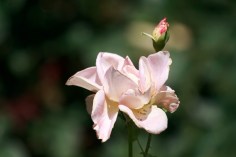
Minature roses. My wife and I love roses. I have found they do very well among the strawberries. The roots provide some permanence to the soil food web, and the flowers attract pollinators. The flower petals can go in salads.
Plum. Stone fruits have not been productive on our cold little spot of land, but I am thinking winters might tend to be warmer in the future. If I am right I get great fruit, if I am wrong I get shade for the understory and leaves for mulch.
Pineapple guava. This evergreen is hardy enough for this land. I enjoy the fruit, and the evergreen plant is attractive in the garden.
Pomegranate. Who doesn’t love some pomegranate seeds in a salad! I have recently learned that I can use the young leaves in a salad as well. That is good news because summers are hot here, and mid-summer salad greens are tough to find! I have a variety in the garden that is hardy enough, but I want to add another for diversity.
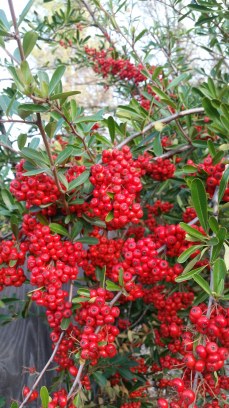
Pyracantha bushes produce loads of red berries in the winter.
Pyracantha. This thorny bush provides a barrier for against deer. It is not edible- as far as I know- but robins love the red berries in winter. And I love to watch the robins eat the berries. My wife also loves to see the bright green foliage and bright red berries in the otherwise dreary winter.
Quince. I have a bunch of apples in the orchard, but no quince. I want to give it a shot with two varieties. They will provide some shade for the understory plants.
Rhubarb. This is being grown because sometimes you do not have enough strawberries for a whole pie, and so you can add the stalks! The huge leaves also shade the nearby soil, and the roots help with diversity for the soil food web.
Rugosa rose. We love roses. Rugose roses provide food for pollinators, petals for salad a deer barrier, and finally rose hips for tea in the winter.
Russian sage and Mexican sage. Both of these plants produce beautiful blue flowers that attract pollinators and provide shade to smaller plants. They also repel the local herbivores.
Sage. We also grow a lot of sage. White sage, tricolor sage, and golden sage. Like lavender, it resists the local herbivores. We can use it for cooking, but mostly we use it as an attractive focal point in the garden. While blooming it attracts many pollinators.
Snow in summer. This plant drapes gracefully over rock raised beds, providing needed shade in the summer. The very attractive small white flowers provide food for the pollinators. The grey-green foliage resists herbivores.
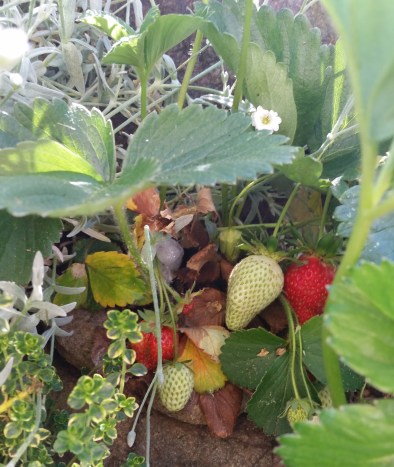
Strawberries hanging over a rock bed, nestled between golden thyme and snow in summer.
Strawberries. I love strawberries! Fresh, frozen, or dried, I can never have enough! I grow them on the edge of rock sided raised beds, and in the voids of these beds. They help to shade the rock walls in summer, keeping the beds cool.
Thyme. We grow a lot of thyme. It is a great groundcover that seems to resist the rodent pressure. I will be planting a number of varieties along the bottom edge of the rock planters where they meet the charred bark paths. Elfen thyme will be planted in the voids of the rock planters. The plant makes fantastic little cushions for the strawberry fruits to nestle in.
White Clover. Clover is a great ground cover that also fixes nitrogen. It will be planted wherever I find bare soil.
*Edit- this list is periodically updated as new plants are identified.

 Our Mountain Ranch Gardens